

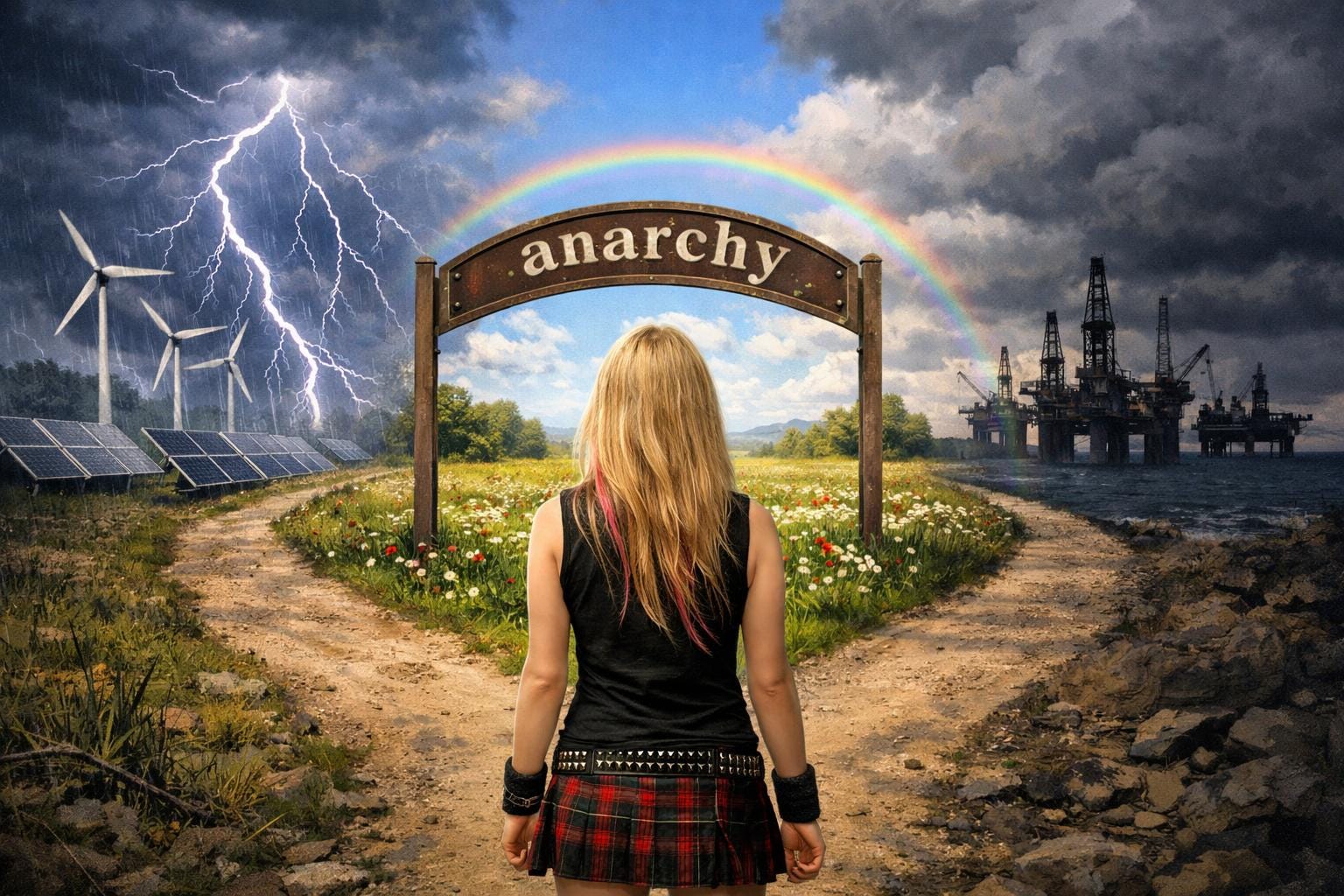
I’m having an existential energy identity crisis, and I’m making it everyone’s problem.
I’ve worked on the full energy stack. I’ve shilled for Canada’s oil sands (tar sands if you’re nasty), carbon capture, and shale gas drilling. I’ve agonised over market access, built out oil-by-rail, and looked at some truly delusional projects to get oil to a coast, any coast.
But I got tired. Attacked by many for oil loyalty; exhausted by peers pretending that climate change wasn’t real.
Eventually I found the debate exhausting enough that I withdrew from energy (and Canada).
I landed in the UK amidst an energy boom of sorts, where deregulation meant that essentially anyone could start an energy retail business. It was fucking madness.
Gas prices rose, which exposed the “fragility” (stupidity) of the system. As a newcomer and now-closeted energy nerd, I spent hours trying to understand what happened and being bewildered by the UK’s energy decisions.
I joined Octopus Energy post-energy crisis, which thrust me into the heart of the net zero movement. Renewables were championed and I was reminded of my genuine belief in the energy transition. I embraced the intricacies of the grid, the promises of flexibility, and the true potential of electrification.
Yet, I was unsettled. At their best, the net zero side were optimistic and inspirational. At their worst, they are wilfully and dangerously ignorant about how the “other side” of the system worked.
The same suspicion and hostility that exhausted me about my fossil fuel brethren existed in the electrification folk. Oh, molecules are molecules, electrons are electrons, and never the twain shall meet.
Energy policy is often performative. The ‘right’ performs loyalty to fossil fuels, the illusion of sovereignty, and “drill baby drill.” The ‘left’ performs loyalty to net zero targets, transitions, and moral urgency.
Both sides treat energy as a signal of virtue rather than what it actually is: a master variable of civilisation.
Energy lives upstream of politics, governed by physics, geography, infrastructure, capital, and time. Throughout history, our civilisations have not been constrained not by ideas or politics, but by how much energy we can capture, convert, and use.
Treating energy as a political or moral badge creates three recurring failures:
Encourages magical thinking. Fossil fuels are framed as enablers of growth without consequence; renewables are framed as easy replacements. Both ignore real constraints, which can delay real solutions and evoke public backlash.
Rewards loyalty over competence. Energy systems always involve trade-offs, but political framing turns these trade-offs into moral binaries. Policy becomes an exercise in maintaining narrative discipline rather than solving problems.
Locks policy into performative targets instead of functional outcomes. Offshoring emissions to hit net zero targets, shouted political slogans, and press releases with empty promises become substitutes for system performance.
Let’s face it: most political systems are currently oscillating between dangerously toxic and tragically ineffective. When systems wobble or break, decisions are rarely made from first principles. As Milton Friedman bluntly put it, “the actions that are taken depend on the ideas that are lying around.”
so, what’s the plan?
Energy policy is in a period of repeated crisis, and most of the ideas “lying around” are almost entirely tribal, performative, or fantastical.
Making sure common-sense energy policy is legible, written down, and emotionally survivable for normal people is strategically necessary.
We’re going to debate, analyse, and dissect policy using first principles, delivering insights and options that are endorsable.
We use real words (acronyms can kindly fuck off) so that the average person can understand what we’re talking about and why it matters to them.
We need to give the people something to pick up.
It’s weird that this is now anarchist behaviour, but you know what they say: anarchy is order.