


The weekly summary of the energy news that caught my eye this week. Also, ICYMI: we set out seven tests that any ‘good’ energy policy should survive.
full anarchy: blind item of the week
SPOTTED: another earnest, middle-power energy darling quietly cozying up to Daddy China.
Official line: a “technical” power trading agreement. Unofficial reality: Maybe watching Canada flirt with Beijing while Trump live-tweets his feelings made this feel less taboo.
The irony: this tentacled brand built its cult following on fighting the system… only to discover the system has very competitive pricing and enormous generation capacity.
Not a scandal. Not a betrayal. Just another reminder that in the great power competition, middle powers don’t pick sides; they pick suppliers.
Daddy China doesn’t do romance. He does capacity.
gas generation goes insane mode
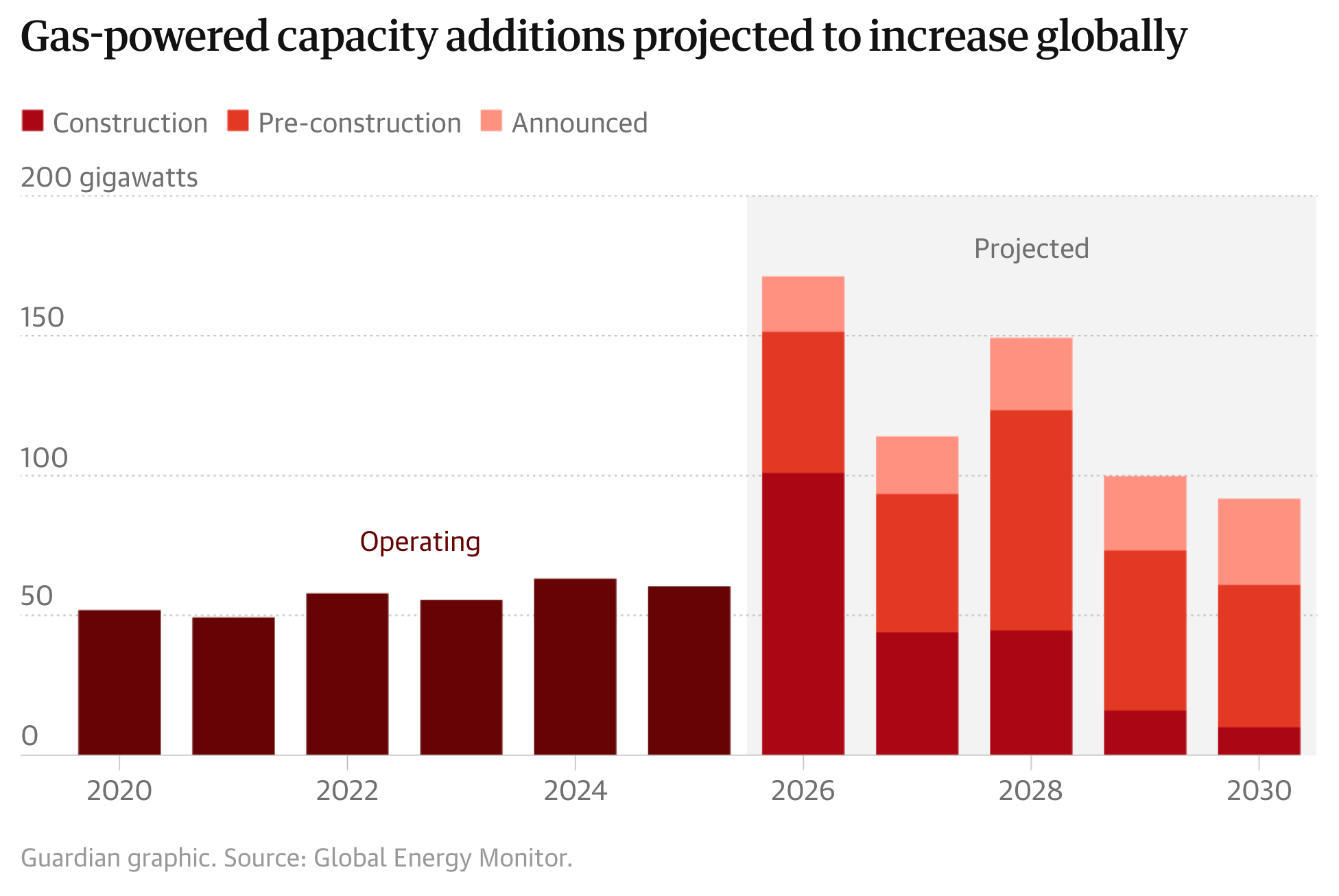
A new report shows a record boom in gas-fired power projects worldwide. Planned gas capacity under development is roughly 50% larger than today’s total, with around 252 GW of new plants tied to AI demand globally. A third of that is in the U.S.; China, Vietnam, Iraq and Brazil are also major developers.
Political support for rapid data centre expansion and weakened clean-energy efforts are helping drive this build-out. If all these projects are built, they’d potentially double U.S. annual emissions.
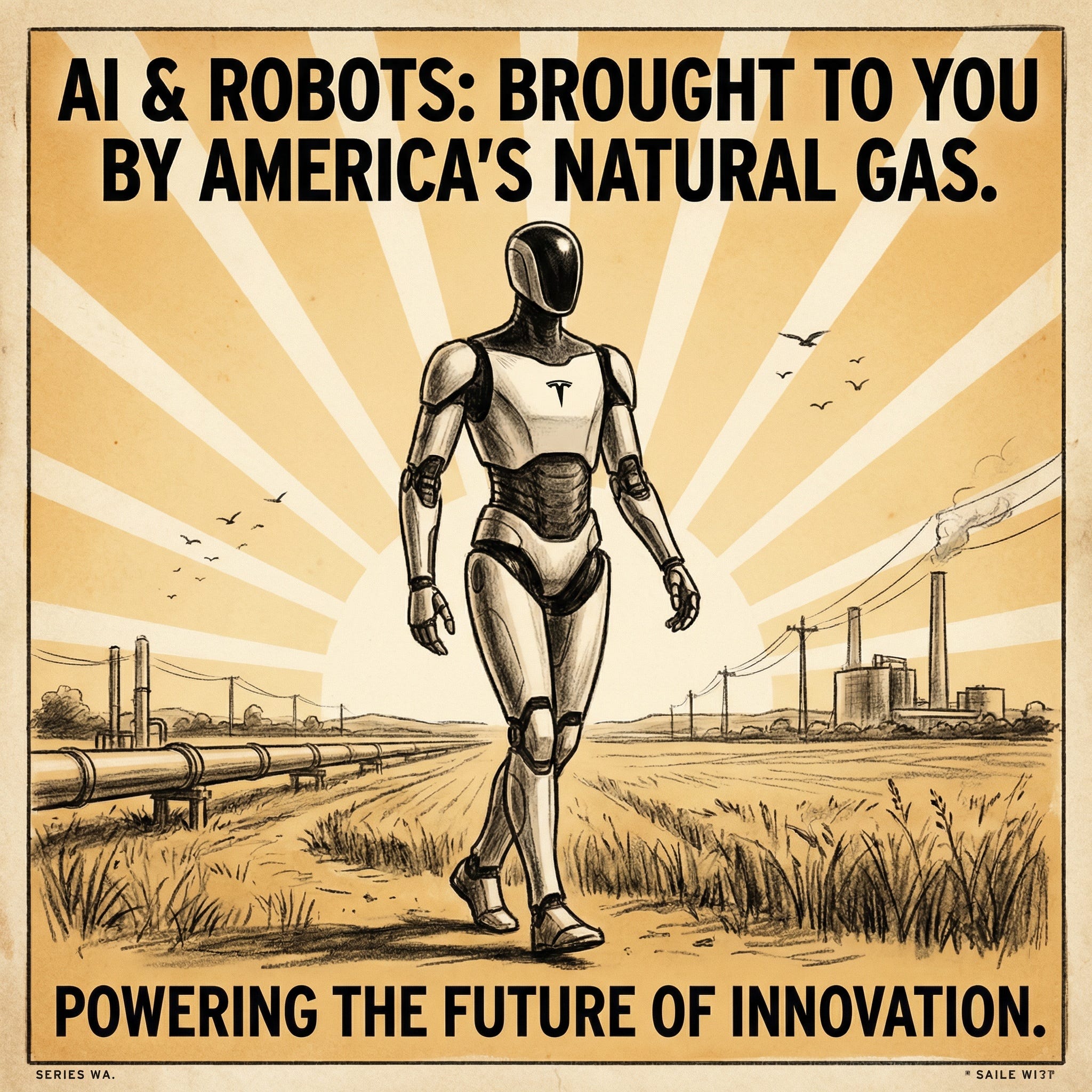
The same forces that are driving Canada and other middle powers into strategic economic flexibility with China are now driving the U.S. deeper into legacy gas lock-in under the banner of our AI technology futures.
Our technology boom is being served by the energy status quo, not a genuinely modernised grid. It’s inertia in a fancy hat.
🏆 winners
Utilities and grid operators
New dispatchable capacity that ostensibly helps meet booming demand from AI data centres. More gas plants = fewer “lights out” headlines (for now).
Tech titans with cheap power needs
Site projects near gas (like Texas, Louisiana) to avoid supply intermittency headaches, at least until someone asks how heatwaves and drought affect gas infrastructure.
Gas developers, exporters, and traders
Drillers, pipeline and LNG infrastructure owners turn on the growth spigot. Forget Porsches and hair transplants: this is the industry’s mid-life crisis remedy.
💔 losers
The Planet
We’re rapidly going backwards on net-zero targets.
Clean Energy Investors & Projects
Policy and capital that could go to wind, solar, storage and grid modernisation are being crowded out or delayed due to the political and financial weight behind gas.
Electricity Consumers
In some regions, gas proliferation is already tying electricity prices to a volatile commodity market. Double bad if you were promised clean, cheap power.
💥 anarchy opportunists
Never let a crisis go to waste.
1. Distributed Clean Power with On-Site Storage
AI data centres aren’t the biggest distributed-energy opportunity overall, but they may be the clearest commercial test case for firm, modular clean power at scale.
2. Grid Flexibility & Demand Management Startups
If data centres actually pay for grid flexibility (they like uptime), firms that manage load shifting, dynamic pricing and demand response could sell a cleaner alternative to “build another gas plant”.
3. Hydrogen & Low-Carbon Dispatchable Technologies
If developers are serious about reliability and climate, there’s a niche for real alternatives to gas peaker plants to get funded on the back of gas anxiety.
4. Public Transparency & Accountability Coalitions
The slow backlash against opaque data centre build-outs, rising bills and local environmental impacts is real. Grassroots organising and regulatory pressure could flip project economics quickly.
Europe Orders Hamburg(er); Discovers Kitchen is Backed Up Until 2032
Category is: renewable energy policy.
€95bn pledged by 10 European countries to turbo-charge North Sea wind and “lock in energy security” in an agreement they’re calling the Hamburg Declaration.
Impressive number. Lovely nouns. Scores, please.

💚 social: make life easier, not test resilience
Score: 4 / 10
In theory, more cheap wind should mean lower bills and fewer price shocks. Unfortunately, this does very little for households this decade.
No immediate bill relief. No simplification of energy systems that people interact with. No reduction in the cognitive load of “navigating the transition”.
This still asks citizens to be patient, flexible, and resilient while infrastructure catches up. Patience is a virtue, but bills are piling up.
🕹️ technology: fetishise function over novelty
Score: 8 / 10
Offshore wind is a boring, proven technology. That’s good. No hydrogen cosplay, no moonshot nonsense, no “AI-enabled decentralised energy marketplace” waffle.
Points deducted because we’re still treating integration (grids, storage, dispatch) as secondary to headline generation. Function includes the whole system, not just turbines.
However, points added for doubling down on a technology that Trump thinks is ‘stupid.’ Excellent trolling.
🛡️ security: reduce leverage over society
Score: 7 / 10
This meaningfully reduces gas leverage, which is one of the most corrosive forms of political and economic pressure Europe faces.
However, it replaces fuel leverage with capital, supply chain, and financing leverage. Better, but not zero.
Still a net security gain.
💶 economic: make it easy to follow the money (it stays close)
Score: 3 / 10
€95bn is waved around, but who pays, who profits, who carries risk, and where returns land remains opaque. Utilities, pension funds, manufacturers, foreign suppliers, public guarantees; all blurred together.
If you can’t trace where value accumulates, you can’t govern it. Until we get more detail, this fails the ‘follow the money’ test.
🌲 environmental: reduce harm over time
Score: 8 / 10
Clear win. Offshore wind displaces fossil fuel generation, cuts emissions, and reduces long-term environmental damage relative to the status quo.
Not perfect, but materially better over time without asking for mass behavioural change.
🏗️ temporal: must be buildable
Score: 4 / 10
Technically buildable. Institutionally sluggish.
Europe keeps announcing capacity faster than it can consent it. Permitting, ports, vessels, grid connections, legal challenges, and workforce constraints remain unresolved at the pace required.
Buildable in theory. Fragile in execution.
🇪🇺 political: Make politics boring again
Score: 5 / 10
Half credit. On one hand, this is infrastructure policy, not culture war theatre. Good.
On the other, it is still drenched in summit optics, declarations, and applause lines about leadership and ambition.
Remember our rule: if a policy needs applause, it usually isn’t ready. This one still enjoys the clapping.
🧮 anarchist score: 6 / 10
By our standards, the Hamburg Declaration is well-intentioned but incomplete.
It scores strongly on technology realism, environmental impact, and strategic direction, but fails on what actually matters to people: near-term social benefit, financial transparency, delivery speed, and boring competence.
This is not bad policy. It is unfinished.
Europe keeps announcing the destination while quietly hoping someone else figures out how to pour the concrete, carry the risk, and stop the lights flickering in the meantime.
Promising. Still not enough.
📚 anarchist read of the week
🇨🇦 One for the Canadian energy nerds. I started reading the Collapse Intelligence Agency when they published their historical primer on Venezuela. I was delighted, then slightly horrified when John Doe published a follow-up dispatch on the Canadian energy industry.

A word of caution: this is not a light read. It’s kind of like watching a new, updated edition of Energy and Civilization be published chapter-by-chapter in real-time.
They promise “the most unbiased and technically comprehensive understanding of how the initial domino of Venezuela will affect the geopolitical and macroeconomic balance of North America and possibly the World” if you commit to reading the dispatches in a particular order.
It’s a commitment but they got a nod from Michael Burry (yes, that one). If it’s good enough for that maniac, it’s good enough for me.