

Welcome to the anarchists who have joined (and thank you for the external validation). If you’re new and like what you’re reading, check out the manifesto and the tenets of good energy policy.
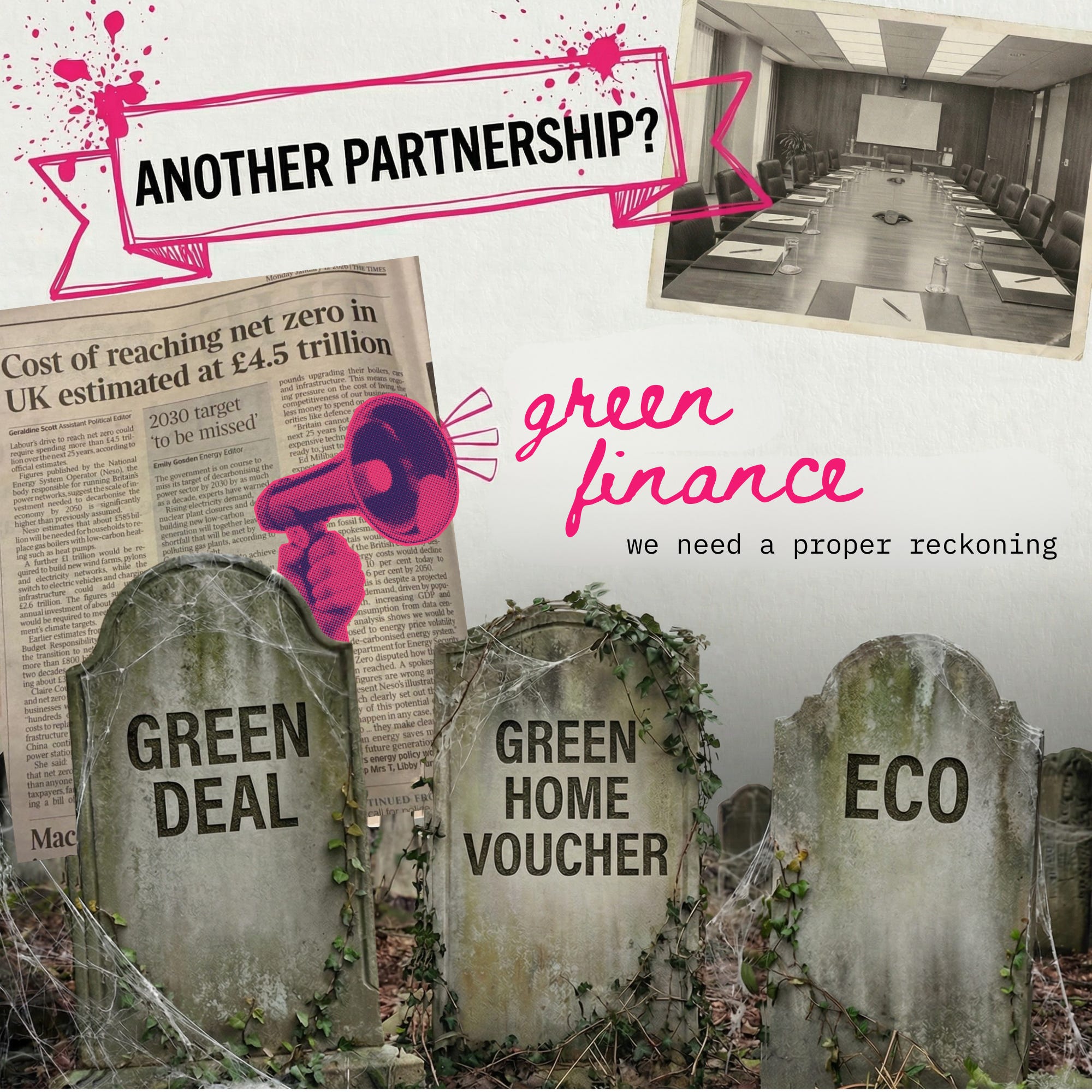
A key follow-on to the recent Warm Homes Plan announcement is the Green Home Finance Strategic Partnership, meant to unblock green finance.
The Green Finance Institute primarily builds coalitions around shared goals and defines frameworks (Green Home Finance Principles, the Green Mortgage Hub) and the Partnership is its latest vehicle.
But it’s time for some real talk.
I’ve counted at least 30 distinct partnerships, task forces, councils, working groups, products, and initiatives in the last ten years whose explicit aim includes some version of unblocking green finance. There’s no shortage of good intentions.
And yet.
Expecting that this partnership will be the magic alchemy that finally delivers a revolution feels naive. Not because the people involved aren’t smart or committed, but because the structural problems that dampened every previous attempt are still present and unaddressed.
We don’t need another partnership. We need a proper reckoning with what a real green finance system actually requires.
the pattern
The UK has a reliable playbook for home decarbonisation finance. Announce a scheme, rush to delivery, skip the structural groundwork, watch it collapse, commission a review, absorb the recommendations, and repeat.
The post-mortem on the Green Homes Grant Voucher Scheme noted, with impressive British understatement: “We are not convinced that the Department has fully acknowledged the scale of its failures with this scheme. […] It is a matter of concern that green homes schemes have repeatedly been short term and have underdelivered on over-optimistic promises on green targets and job creation.”
The underlying reason isn’t organisational, and the UK does not lack green capital.
It’s structural.
The UK has treated home decarbonisation as a consumer lifestyle choice, funded by grants, delivered through supplier schemes, and backstopped by the government. This guarantees three outcomes: low uptake, endless pilots, and permanent subsidy dependence.
Then there’s the political reality. A growing share of people no longer reject climate science, they reject the bill. Roads are potholed, councils are bankrupt, the NHS is stretched, and taxpayers are being asked to underwrite heat pumps, EVs, and green finance experiments. The backlash is not irrational.
New York is currently debating whether its Climate Act is financially survivable. The state’s own analysis projects $4,000 in additional household energy costs. Governor Hochul’s budget director is publicly hinting at rolling back the law.
This is not a fringe revolt. It is a progressive state discovering that political will and structural design are not the same thing.
If the affordability problem isn’t solved structurally, the political and public support for net zero collapses. Finding a funding model that doesn’t land primarily on bills or rely entirely on subsidies is existential for the transition itself.
There is a second failure mode sitting alongside. The entire supply side (manufacturers, installers, heat pump companies, insulation providers) has spent years waiting for consumer finance to unlock mass demand. The theory is seductive: reduce the monthly cost, reduce the friction, watch adoption climb.
So the push is always the same. More finance products. Better rates. Longer terms. The problem is that consumer credit only meaningfully moves demand when the interest rate approaches zero.
As the former Commercial Director for the UK’s largest installer of low carbon tech, I lived this firsthand. Researchers also looked at 13 financing instruments across the EU and explicitly confirmed that consumer finance with market-rate interest does not drive retrofit uptake.
Charge anything close to an unsecured market rate and you get negligible uptake. So you subsidise the rate. Suddenly you haven’t built a finance market, you’ve built a hidden grant with extra paperwork and a credit check.
my green finance vision board
Full disclosure: this will horrify some folks who have UK Green Deal PTSD or experienced the US’s PACE debacle. Stay with me until the end. I hope to ease your anxiety… or at least give you cannon fodder for yelling at me in the comments.
What would durable, market-based green finance look like?
Obviously, there is no silver bullet; the right answer is obviously a multi-layered system. In this piece, I’m focused on a solution for dispersed, owner-occupied homes.
In a perfect world, this sits alongside things like robust district heating and heat network projects, the UK’s version of Energiesprong for retrofitting social housing, and other initiatives targeting renters.
First principle: Don’t use public money where private money works.
We must stop using public money to subsidise every element of this transition.
Sentiment towards net zero is changing, and even the UK’s top climate chief warns that the government will lose public support if they don’t figure out how to distribute costs fairly.
One of the criticisms of the Boiler Upgrade Scheme is that it funnels public money towards people who are more likely to have afforded a heat pump. This is valid. It’s public money transferred directly to (arguably) asset-rich homeowners, with no obligation to repay.
We should seek to use private capital, without subsidy, where it makes sense so we can concentrate public money where it’s needed and where private capital cannot go: social housing, private renters, the hardest-to-treat, and most vulnerable stock.
Rather than spreading grants thin across all housing types and achieving nothing at scale anywhere, build deliberate segmentation.
Second principle: Attach the finance to the property, not the person
Humans have annoying habits. They move, remortgage, lose their jobs, divorce, and die. All of these events create default risk in consumer credit models, which is why green loans carry high interest rates.
A property-linked energy upgrade charge that
attaches to the property title
sits junior to the primary mortgage (this is important for reasons I’ll explain later)
transfers to the next owner on sale
collects via a ring-fenced statutory channel
produces something that looks far more like infrastructure debt than retail credit.
This changes the asset class. Default risk drops; bundle thousands of these together and you have exactly the kind of steady, boring, long-duration return that pension funds love.
Imagine that your boiler is dying. You want a heat pump but don’t have £15,000 in cash. Under this model, the upgrade attaches to the house, not to you. If you sell in five years, the next buyer takes on the remaining charge. Just like they inherit your kitchen design choices.
This also helps to remove the “I’ll wait until I’m in my forever home” objection to installing a heat pump or solar panels that I’ve seen time and time again.
Third principle: Cash before carbon
A credible system sizes repayments so that energy bill savings materially offset servicing costs, and household cash flow doesn’t spike on day one.
If an upgrade cannot plausibly neutralise household cash flow over the life of the asset, it is not a finance problem. It is a technology or deployment problem (or perhaps a structural energy pricing problem 😬), and it should definitely not be scaled with public money.
(If one was being pedantic, she could argue that mass electrification is an insane policy unless the spark gap is closed… but that’s another topic for another day.)
If we believe that low carbon tech increases property values (Rightmove’s 2023 Greener Homes report was bullish on this; the 2025 version is more tepid) and materially decreases energy bills, this math should math.
Fourth principle: Risk sits with private capital
Investors receive yield because there is risk.
The UK has developed an embedded assumption that government should underwrite adoption risk, guarantee performance, and absorb the downside, while private actors claim the upside.
That is not transition finance. It is risk laundering, and taxpayers should be considerably angrier about it than they are.
Public money is justified only where the state captures upside, or where risk is genuinely uninsurable and temporary. IMO, most UK green finance fails both tests.
learning from others
Deep breath. The closest real-world model for this is the US Property Assessed Clean Energy (PACE) programme. PACE attaches finance to the property tax bill; non-payment is treated as tax arrears, not loan default.
PACE unlocked billions in private capital and proved that consumer demand for deep retrofit surges when you remove the upfront barrier and attach the debt to the property rather than the individual.
It also produced significant fraud due to mis-selling and a mortgage market fiasco.
In many US states, property taxes are senior to the mortgage, which means a random solar panel installation could hold super-priority lien status. Mortgage lenders revolted. Fannie Mae and Freddie Mac eventually barred PACE-encumbered properties. Many people lost a lot of money.
Obviously, we should not copy this like-for-like.
Placing the charge junior to the mortgage calms lenders, but it is not a costless concession. A junior lien removes the enforcement security that made PACE-style instruments cheap to fund. The pricing only holds if something else compensates for it: a statutory collection channel, with teeth, that makes default genuinely difficult and expensive.
Collect via council tax billing (or an equivalent statutory mechanism) means the instrument could likely stay fundable at infrastructure-debt pricing. Leave collection to a retail lender and you reintroduce the default risk that we are trying to price out.
This should take care of the mortgage fiasco risk. Now onto the fraud.
The UK does not have a brilliant track record. Where do we look for exacting technical rigour? Enter Germany.
Germany’s KfW renovation loans are tied to engineering standards. An Energieberater produces the technical plan. The bank grants the loan based on it. The consultant supervises the renovation and verifies completion. If the building doesn’t meet the target Effizienzhaus standard, the repayment bonus is reduced or reclaimed, and KfW performs random audits. Falsified paperwork triggers financial penalties for both homeowner and consultant.
Does this add friction and slow it down? Yes. (German is behind on its efficiency targets; analyses blame property owners for behaving economically irrationally. The nerve.)
Does it reduce fraud? Also yes.
A UK system must borrow both things: the structural property-linkage from PACE, and technical gatekeeping discipline from Germany. We need to fundamentally change the implementation errors of the past.
Some potential reforms to consider:
Finance should only available for pre-approved retrofit pathways, from genuinely accredited installers who are audited properly. (Does giving this responsibility to the monopolistic MCS fill me with dread? Yes.)
Every project should require scoping and sign-off from an accredited retrofit coordinator who is audited, held accountable for long-term performance.
Disbursements should be staged (something like 30% on design approval, 50% mid-installation, 20% only after verified performance).
Stress test the incentive loopholes: retrofit coordinators shouldn’t work on commission; installers cannot recommend finance providers; finance providers cannot recommend installers.
the implementation reality
Politicians want big targets for headlines and quick wins, but fail to acknowledge operating realities. It’s how £50 million was spent on the Green Homes Grant administration before scrapping it within two years.
To make a property-linked energy charge real in the UK, we need approvals across law, finance, regulation, and politics. Miss one and the whole thing collapses into another Green Deal-shaped crater.
1. Primary legislation. Parliament must create a new statutory charge attached to property. A legal instrument that runs with the land, is registered at the Land Registry, transfers automatically on sale, survives borrower bankruptcy, and has clearly defined enforcement rights. Without this, we have unsecured credit wearing a cape. Fail.
2. The seniority negotiation. Decide where the charge sits relative to the mortgage: senior, pari passu, or junior. If it’s junior, pricing rises. In the UK, we need HM Treasury, UK Finance, major lenders, and possibly the Bank of England to agree on a workable hierarchy. If it’s senior, lenders revolt. If it’s unclear, nobody touches it. Fail.
3. FCA regulatory treatment. The FCA determines whether this is regulated credit, a tax-like levy, or a new category entirely. If this ends up classified as standard unsecured consumer lending, the interest rate economics collapse immediately. Fail.
4. Collection mechanism. This is a load-bearing detail. Low default rates require a collection channel that is low-friction and difficult to ignore, so it’s a prerequisite for cheap finance. The logical candidate is council tax billing, or a similarly statutory mechanism. That requires DLUHC approval, local authority buy-in, and system changes. Basic direct debit? Fail.
5. Treasury’s quiet backstop. Full state subsidy is neither necessary nor desirable. But we probably requires one of: first-loss protection, a partial guarantee, or eligibility for infrastructure-style capital treatment. That requires Treasury sign-off. No support? Fail.
6. PRA capital treatment. Banks need regulatory clarity on capital weighting, risk treatment, and balance sheet impact before they will originate at scale. If holding property-linked retrofit charges consumes disproportionate regulatory capital, banks will not participate regardless of the policy rationale. Fail.
7. Land Registry integration. Less glamorous, but genuinely critical. The charge must appear clearly on title, be automatically searchable, be visible during conveyancing, and transfer without friction on sale. If conveyancers treat it as a defect or an anomaly that requires resolution, transactions stall. Fail.
8. Quality governance. If installation quality collapses, the financial model dies politically and possibly legally. Mandatory technical assessment, certified design, post-install verification, performance sign-off, and clear dispute resolution are not optional extras. They are the mechanism that prevents this becoming a(nother) national scandal. Double fail.
9. Political cover. Cross-party support. Explicit messaging that this is not a Green Deal reboot. Mortgage lender reassurance in public. Clear differentiation from grant chaos.
10. Capital markets architecture. Securitisation framework, standardised documentation, pooled issuance, and visible demand from long-duration investors. Pension funds and insurers need to see “predictable, inflation-linked, boring.” If they see “policy risk, political volatility, unclear seniority hierarchy,” they walk and they don’t come back. Fail.
This is not a policy tweak. It is a structural market creation of a new asset class. None of it is impossible, but it is not easy nor quick.
why this isn’t the green deal 2.0
UK folks are probably convulsing at this point. Thanks for sticking with me.
The Green Deal tried to bolt consumer credit onto energy bills and hoped savings would magically cover repayments. It was not infrastructure finance. It was awkward retail credit dressed up as green policy, with optimistic assumptions standing in for underwriting discipline and political enthusiasm substituting for legal architecture.
The property-linked model described here is different in every structural dimension.
It is legally defined property-linked infrastructure, not consumer debt.
It sits junior to the mortgage and is transparently recorded on title registers.
It is priced as long-duration asset finance, not retail credit.
It does not rely on hypothetical bill savings; performance is contractually verified before the final disbursement is released.
The repayment logic is: “This improves the property. The property carries the charge.”
Not: “Trust us, your bill will magically fall.”
One more distinction worth making. The Green Deal was killed partly by the political environment, partly by weak design, and partly by the absence of any institutional infrastructure to support it.
A properly built property-linked system, once established, has a self-reinforcing quality: the asset class becomes familiar, lenders build origination capability, insurers understand the risk profile, and the political cost of dismantling it rises.
That is how you build something that outlasts the government that created it.
Warm Homes Plan: a live diagnostic
The Green Home Finance Strategic Partnership has organised itself into working groups and the chairs are credible. Could this finally be the right vehicle for proper reform?!
Working Group 1 (chaired by UK Finance) focuses on innovation and incentives. I firmly believe that if a green finance solution cannot be explained without mentioning “innovation”, it is not finance. It is marketing.
But alas, if they go down the asset class creation route, UK Finance is the right institution for the seniority negotiation, PRA capital treatment, and the conversation with mortgage lenders about where a property-linked charge could sit in the hierarchy. These are checklist items 2, 5, and 6, which are the most technically fraught and politically sensitive.
Though, resolving the lien hierarchy requires HM Treasury and the Bank of England at the table, not just the banking trade body. This group also needs to tackle the primary legislation in checklist item 1.
Working Group 2 (chaired by GFI) focuses on shaping “government-backed loan initiatives”, which worryingly sounds like an improved Green Deal. If WG2 produces a better-designed loan scheme rather than a statutory property-linked instrument, it will have done useful work in entirely the wrong category.
If they decide to look at property-linked products, this is the natural home for FCA regulatory treatment and capital markets architecture (checklist items 3 and 10).
Working Group 3 (co-chaired by Nesta and the Finance & Leasing Association) focuses on driving demand and standardised consumer journeys.
With the deepest respect to the people working on this: I’ve sat in many cross-party discussions about standardising consumer journeys for decarbonisation. I have yet to see one yield real-world impact.
A smoother application journey doesn’t change the underlying economics. And as argued above, consumer finance at any rate that resembles a market rate does not move demand.
The item this group should be addressing is the collection mechanism: what statutory channel makes default rare enough to price the instrument as infrastructure rather than retail credit.
Working Group 4 (chaired by Energy UK) focuses on enhanced consumer protections and standards as they relate to finance. This maps to checklist item 8 — quality governance. Energy UK is a reasonable chair. The output to watch for is whether the standards framework has teeth: mandatory independent verification, financial consequences for non-compliance, and audits.
The 98% non-compliance rate on previous schemes happened under a voluntary regime, just saying.
the awkward truth(s)
The first: Finance cannot rescue unviable economics, and producing a cash-neutral deep retrofit is really fucking hard.
Recent academic analysis of 44 deep renovation scenarios across German housing types — using KfW’s own model, in the country with the best-run retrofit finance system in the world — found that none of them pay back in monetary terms over 25 years. Why?
Official energy performance ratings systematically overstated actual household consumption (by 30 to 40 percent), which skewed savings calculations.
Construction costs up 43% since 2020.
Finance costs up ~300% since 2021 (from 1% to 4%).
For targeted interventions (like a heat pump replacing an end-of-life boiler), the economics are manageable and property-linked finance probably works as described.
For whole-house deep renovation, the honest answer is that debt financing alone probably cannot close the viability gap. This doesn’t mean we should abandon the model; we must be precise about which upgrades the model can and should fund without subsidy and which ones it cannot.
The second: Even free money does not automatically produce demand.
You can build the perfect financing instrument, but most households do not wake up craving a deep retrofit. Trust, hassle, change anxiety, prioritising other things, and plain behavioural inertia matter just as much.
(Also, fewer people can even think about any upgrades. Nearly half of Britons have less than £25 in spare cash at the end of the week, and nearly two-thirds of adults are cutting back on essentials like food and heating.)
the verdict
The Green Home Finance Strategic Partnership is at a fork, and it needs to pick a path.
Option one: optimise what already exists. Better-designed consumer loan products, a government backstop, reduced friction, ‘best practices’ for consumer journeys delivered in a nice downloadable PDF. Feasible. Deliverable within the current working group structure. A ‘quick win.’
A government-backed consumer loan also uses public money where private money could work. It follows the person, not the property, so all the default risk remains. Its economics depend entirely on the subsidy lasting. And with a state guarantee behind it, risk sits with the taxpayer while lenders and private actors retain the yield.
You get one or two nice press releases before obscurity.
Option two: build a new asset class. Statutory property-linked charge, junior to the mortgage, collected via council tax billing, structured for long-duration institutional capital.
You won’t get a quick win within 12 months, but you will get something that will probably endure for decades, safe from changing political whims. And you’ll break the generational curse of retrofit scandals.
The working groups as currently scoped could deliver option two, but only if their mandates are stretched. “Innovation and incentives” needs to mean primary legislation and lien hierarchy resolution, not product iteration. “Consumer journeys” needs to become the statutory collection mechanism question. If HM Treasury and the Bank of England are in the room, not just the usual industry suspects, this Partnership is different from the previous thirty. If they don’t, it isn’t.
The UK’s switch from coal to natural gas is described as “the greatest peacetime operation in the nation’s history.” In under a decade, 40 million appliances were converted in 14 million homes.
Believing we can deliver the transition that will define the next century of heating by dressing up unsecured consumer lending in a prettier coat is naive.
It’s time to do the hard thing.
Love this Jessica, whole heatedly agree - it’s time to do the hard thing! It is the only way long term, having worked with the GFI as advisor since 2019 I’m now crying out for PLF to be delivered with all the lessons learned from PACE and your excellent suggestions here. Alternatively, Pension Fund money could already solve this through forward financing if working with the right partners to deliver - the data supports it. I’ve successfully completed a zero bills home on a 1920’s 3 bed semi and a deep retrofit wasn’t required, just optimisation of every technology and tariff. It can be done!