

Welcome to the anarchists who have joined since our inaugural post! (And thank you for the external validation.) Join them by subscribing here:
“New York set bold climate targets, but ignored the economic and technical realities required to achieve them.”
This depressing statement came from Neel Brown, Managing Director of PPI and co-author of a recent report called “New York’s Climate Crossroads: Assuring Affordable Energy.”
[Props to Energy Bad Boys for their coverage, which caught my attention.]
This perfectly encapsulates the point of my last post: treating energy as a moral or political badge locks societies into bad policy. (From PPI’s report: “New York’s current energy strategy is driving up costs for families, constraining reliable supply, and jeopardizing the political viability of the state’s climate agenda.” Awkward.)
Whilst energy itself is not moral, energy policy has a moral obligation to protect ordinary people from avoidable system failure. Bad policies impose avoidable harm by pretending physical, economic, or temporal constraints do not exist.
To score policy, we need first principles.
Not targets. Not slogans. A manifesto (drawing inspiration from the original anarchist tradition, particularly Anselme Bellegarrigue).
We are not anti-state, anti-market, or anti-technology. We are anti-delusion.
the energy anarchist manifesto (v1.0)
This is v1.0 because changing your mind in response to evidence is not weakness; it is the minimum requirement for competence. Consistency is great for McDonald’s franchises; it’s anathema to critical thought.
Also, because this should be a group exercise. Share your thoughts, critiques, edits, and omissions in the comments and you might see them pop up in future versions.
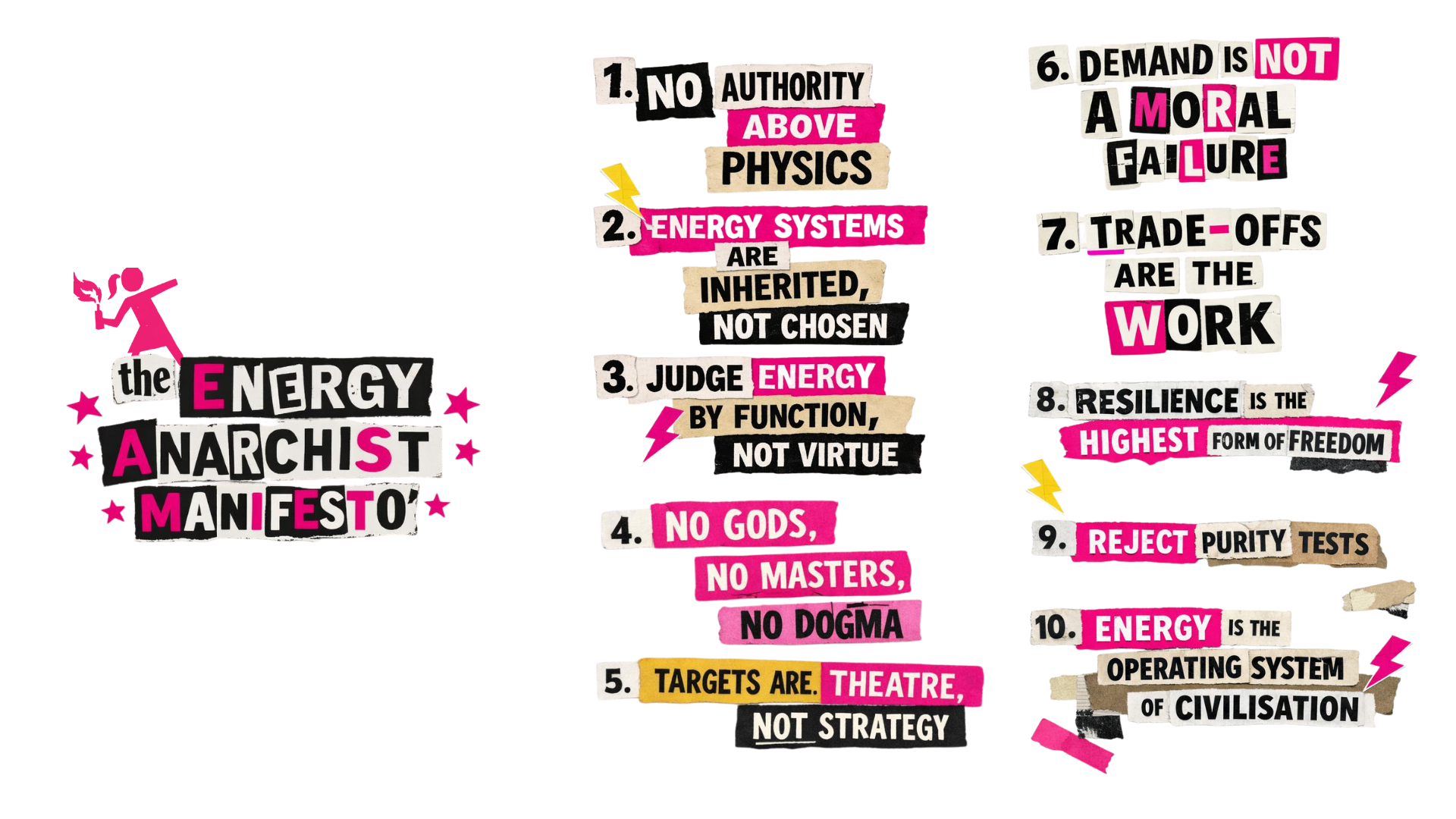
1. No Authority Above Physics
Traditional anarchists argued that no ruler holds legitimate authority over the individual. In energy, the equivalent truth is more brutal: no institution holds authority over physical reality.
Governments may set targets. Markets may set prices. Politicians may shout slogans. None of these can override thermodynamics, energy density, material limits, or time.
2. Energy Systems Are Inherited, Not Chosen
Anarchism rejects the fiction of consent under coercive systems. We reject the fiction of free choice under inherited infrastructure.
Societies do not select energy systems; they inherit them. Grids, pipelines, power stations, skills, and supply chains are the product of decades of accumulated decisions and sunk capital.
No society has ever voted its way out of an energy system overnight.
Every transition has been slow, additive, and shaped by materials, labour, and time. (See: Energiewende)
Policy that ignores this inheritance is not visionary; it is unserious.
3. Judge Energy by Function, Not Virtue
No energy source is morally pure.
Fossil fuels, renewables, nuclear, storage, and demand reduction all impose costs and create dependencies. They must be judged by what they deliver, what they displace, and what they lock in.
4. No Gods, No Masters, No Dogma
Anarchism is often interpreted as a demand for decentralisation. In energy anarchism, we reject architectural dogma.
Centralised systems offer scale, coordination, and reliability. Decentralised systems offer resilience, flexibility, and local optimisation. Both fail when treated as ideologies rather than tools.
Debate each approach on what it will deliver, and deploy each where it reduces risk and improves system performance. Centralisation and decentralisation are engineering choices, not theology.
5. Targets Are Theatre, Not Strategy
Classical anarchism rejects rule by decree. Energy anarchism rejects policy by proclamation.
Targets without credible pathways are not plans. They are assertions of authority over systems that do not recognise it. (cough*New York*cough)
Energy infrastructure does not adhere to the “shoot for the moon; even if you miss, you land upon the stars” bullshit. When ambition outruns infrastructure, the result is not progress: price shocks, rising costs, emergency interventions, and political backlash.
[Sidebar: Kerry Clapp published a data-driven critique of the shifting climate targets. The comment section is wild, with great examples of dogmatic hand-waving alongside some very thoughtful commentary.]

6. Demand Is Not a Moral Failure
Modern societies consume large amounts of energy because they are complex, interconnected, and technologically intensive. Healthcare, food systems, transport, communications, and industry are energy-intensive by our own design.
Treating demand as a moral failing confuses consequence with cause.
Reducing demand may be necessary. Pretending it is painless or universally available is dishonest. Designing systems that fail people and then blaming them for consumption is worse.
This logic does not stop at national borders. Billions of people still live in energy poverty. Denying developing countries access to abundant, reliable energy in the name of virtue is not climate leadership; it is imposed stagnation.
Energy poverty is not a behavioural problem. It is a system failure.
7. Trade-offs Are the Work
Every energy decision involves trade-offs between cost, reliability, emissions, speed, land, materials, and risk.
Refusing to name these trade-offs pushes them onto the most vulnerable or into the future, and ultimately undermines public trust and confidence.
Ideological systems collapse trade-offs into betrayals. Energy anarchism treats trade-offs as the substance of policy, not an embarrassment to be hidden.
8. Resilience Is the Highest Form of Freedom
For Bellegarrigue, freedom meant autonomy from brittle authority. In energy systems, freedom means resilience.
A system that fails under stress is not liberating, no matter how virtuous its intent. A resilient system preserves agency, safety, security, and social stability.
If you want something to keep you up at night, read the UK’s National Preparedness Commission report. They’ve concluded that the UK is running a civilisation-scale energy system that cannot withstand disruption. The energy and industrial foundations lack redundancy, depth, and shock tolerance, leaving modern life fully exposed to cascading failure.
This is not a resilient system. It is a system that assumes nothing goes wrong.
9. Reject Purity Tests
Anarchism rejects absolute doctrines. Energy anarchism rejects purity tests.
Progress comes from optimisation across imperfect options, not from waiting for perfect solutions.
Hybrid systems, transitional technologies, and compromises are not signs of failure; they are how complex systems actually evolve.
10. Energy Is the Operating System of Civilisation
Energy is not a sector, a culture war, or a branding exercise.
It is the operating system on which healthcare, food, transport, industry, communication, and social order depend.
Breaking it for ideological satisfaction is reckless.
The goal is not to defend fossil fuels or sabotage decarbonisation. It is to stop pretending that energy is a moral costume drama instead of critical infrastructure.
In his pre-COP30 memo, Bill Gates argued that the climate community is too focused on near-term emissions goals, which is diverting resources from the most effective things we should be be doing to improve life:
“…we should measure success by our impact on human welfare more than our impact on the global temperature, and that our success relies on putting energy, health, and agriculture at the center of our strategies.”
On this, we agree. If energy policy continues to be treated as an extension of political identity, it will continue to fail at the one thing it exists to do: keep societies functioning while reducing harm.
OK, very much enjoying the posts. One nit: energy isn't an operating system any more than ATP or glucose are operating systems for the body (CNS is more the operating system). Maybe you could get away with "circulatory system" or maybe "mana" or "breath of life" or something.